SV | EN
2026-05-25
Wind Power in Denmark
In Sweden, wind power companies are suffering huge financial losses. How is the situation in Denmark? Denmark is often described as the world’s leading wind power country. Is that true?
⇑ Major Consequences for Sweden
Starting in 2026, the rules will become stricter, forcing greater carbon storage in forests and land.
1. Stricter Carbon Sink Requirements (Forestry Sector)
Increased binding target: Sweden has been given one of the most ambitious targets in the EU and must increase the sequestration of carbon dioxide in forests and land by approximately 4 million tonnes of CO2 equivalents by 2030, compared with the reference period 2016–2018. To achieve these targets, it may become necessary to reduce forest harvesting, creating a conflict between climate goals and the forest industry's production of renewable raw materials. If harvesting decreases, Swedish forests will become older, which in turn increases the risk of damage from insects, fires, and wind, and may reduce forest growth rates in the long term.
2. Economic Effects
Reports indicate that stricter LULUCF targets could threaten 35,000 Swedish jobs in the forestry industry[1]. Reduced availability of timber products could negatively affect the Swedish economy. If Sweden fails to meet the binding targets for carbon uptake, the country risks fines.The regulatory change affects facilities with less than five percent fossil emissions, which from 2026 onward will no longer be allocated free emission allowances. In Sweden, this means that more than half of the facilities, 25 out of 45 pulp and paper mills, will lose emission allowances with an estimated value of SEK 1.5 billion per year.
The negative effect is reinforced by the fact that facilities excluded from the emissions trading system must also pay full carbon tax on their remaining fossil emissions. The cost is estimated at SEK 130–250 million per year until the facilities are covered by the new ETS2 system in 2028. Swedish pulp and paper mills that have transitioned faster than their European competitors therefore risk both lost revenues and increased costs of up to SEK 1.85 billion per year. [2]3. Changed Forestry and Land Use
Forests are no longer valued only as a resource for timber but as a critical "carbon sink" (storage for carbon dioxide). Challenges with drained peatlands: Emissions from drained peatlands (both forest and agricultural land) are receiving greater attention, since they account for large carbon dioxide emissions. The new land directive will impose requirements for monitoring soil health and restrictions on how land may be sealed or hardened.
4. Conflict Between EU Level and National Level
Detailed regulation from the EU: Swedish researchers and the forestry industry are critical of the EU micromanaging how Swedish forests should be managed, which has previously been a national issue. Biomass vs. fossil fuels: There is a goal conflict where Swedish forestry wants to replace fossil products with wood-based ones, while the EU directive prioritizes keeping the carbon stored in the forest.
⇑ The Costs of LULUCF
The costs of Sweden’s LULUCF commitments are uncertain. Assessments indicate that they could amount to several tens of billions of kronor.
If Sweden misses the net sink target (reduced carbon uptake in forests), the costs could become very high, where a shortfall of 10 million tonnes of carbon dioxide could correspond to costs in the order of SEK 10 billion per year. According to the government’s emission forecasts and the EU’s price forecasts for emission units, costs are expected to amount to tens of billions.
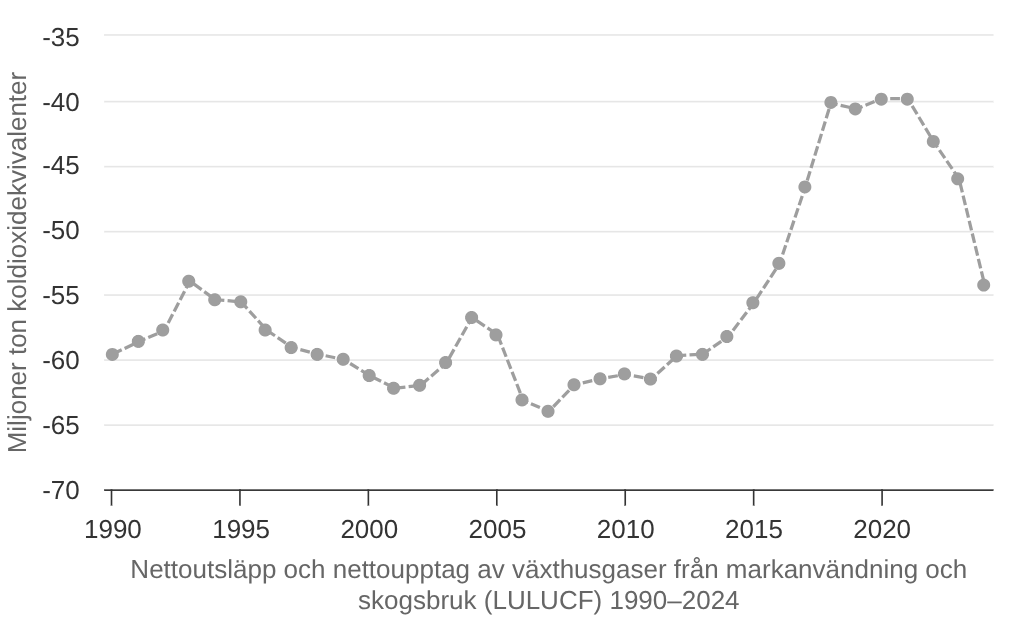
Net uptake in the Swedish land-use sector has decreased compared with the 2016–2018 average and amounted to 41.2 million tonnes in 2022. It is difficult to assess the exact cost of purchasing LULUCF units from other countries, but this is a conceivable solution if Sweden does not achieve its own targets.
⇑ The LULUCF Regulation
It is a sector within climate reporting that describes how land and forests affect greenhouse gas emissions. Unlike other sectors (such as industry or transport), which almost only emit greenhouse gases, the LULUCF sector can both emit and store carbon dioxide.
The sector is divided into different types of land use that affect the carbon balance in different ways:
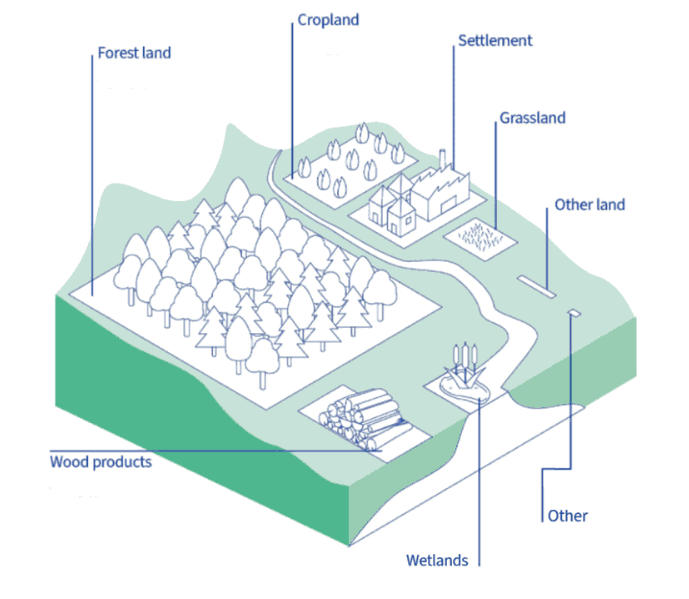
- Forest land: Growing trees absorb carbon dioxide through photosynthesis. The forest then functions as a "carbon sink." If the forest burns or is harvested, the carbon is released again.
- Cropland and grazing land: The way the soil is managed affects how much carbon is stored in the ground.
- Wetlands: Drained wetlands can be major sources of emissions, while natural wetlands function as carbon stores.
- Built-up land: When forests or agricultural land are converted into roads or housing, the ability to store carbon decreases.
⇑ Regulation – Not Directive
LULUCF is not a directive, but a regulation (the LULUCF Regulation). Unlike a directive, which must be incorporated into national legislation, an EU regulation is directly binding in its entirety for all member states.⇑ Land Use in Sweden
Sweden’s land area is 410,000 square kilometres or 41 million hectares. Of this area, 68 percent is forest land and 7 percent agricultural land. Built-up and developed land accounts for no more than 3 percent of Sweden’s total land area. Open mires and other open land with and without vegetation, as well as glaciers, account for 22 percent.
Every five years, Statistics Sweden produces statistics on how land is used in Sweden. The statistics are based on a combination of map material and data from various registers.
Two-thirds of Sweden consists of forest land
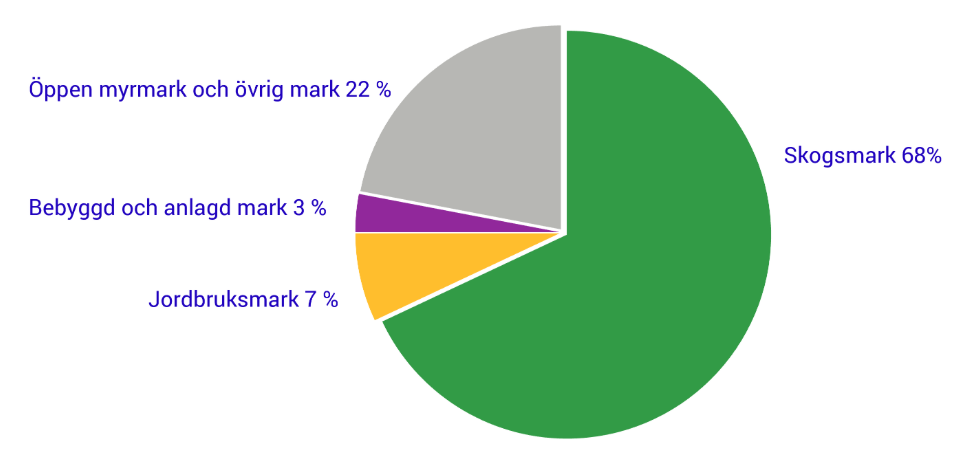
Perhaps the most striking fact is how large a share of the country consists of forest land, as much as 68 percent. This means that Sweden, after Finland (73 percent), is the country in Europe with the highest proportion of forest land.
Of Swedish forest land, 84 percent is productive forest land. This means that it is of such quality that it is suitable for forestry production. The remaining 16 percent is unproductive forest land, which is not suitable for forestry production. This includes mountain coniferous forests or forests located on marshland and rocky terrain.
The counties with the densest forests are Gävleborg and Västernorrland, where 89 and 85 percent respectively of the land area consists of forest land. The largest forest area is found in Norrbotten County with 5.7 million hectares. However, this still corresponds to only 58 percent of Norrbotten’s large land area.
⇑ Tips
Do you have suggestions for improving this article? Correct something you believe is wrong or missing. Write to hibratt@brarttnet.com.